Nritta
Abstract or “pure” dance: rhythmic movement, adavus, sculptural lines, jumps, turns, and mathematically shaped patterns.
A living classical tradition
Explore the history, technique, music, meaning, and continuing practice of Bharatanatyam and India’s classical dance traditions.
Bharatanatyam is a South Indian classical dance tradition in which rhythm, geometry, gesture, expression, poetry, costume, and music work as one. A dancer does not merely execute steps: the body becomes an instrument of rhythm and a vehicle for meaning.
Its vocabulary can be precise and codified, but the art is never mechanical. Years of training help a dancer move from memorizing form to communicating intention, character, emotion, and musical nuance.
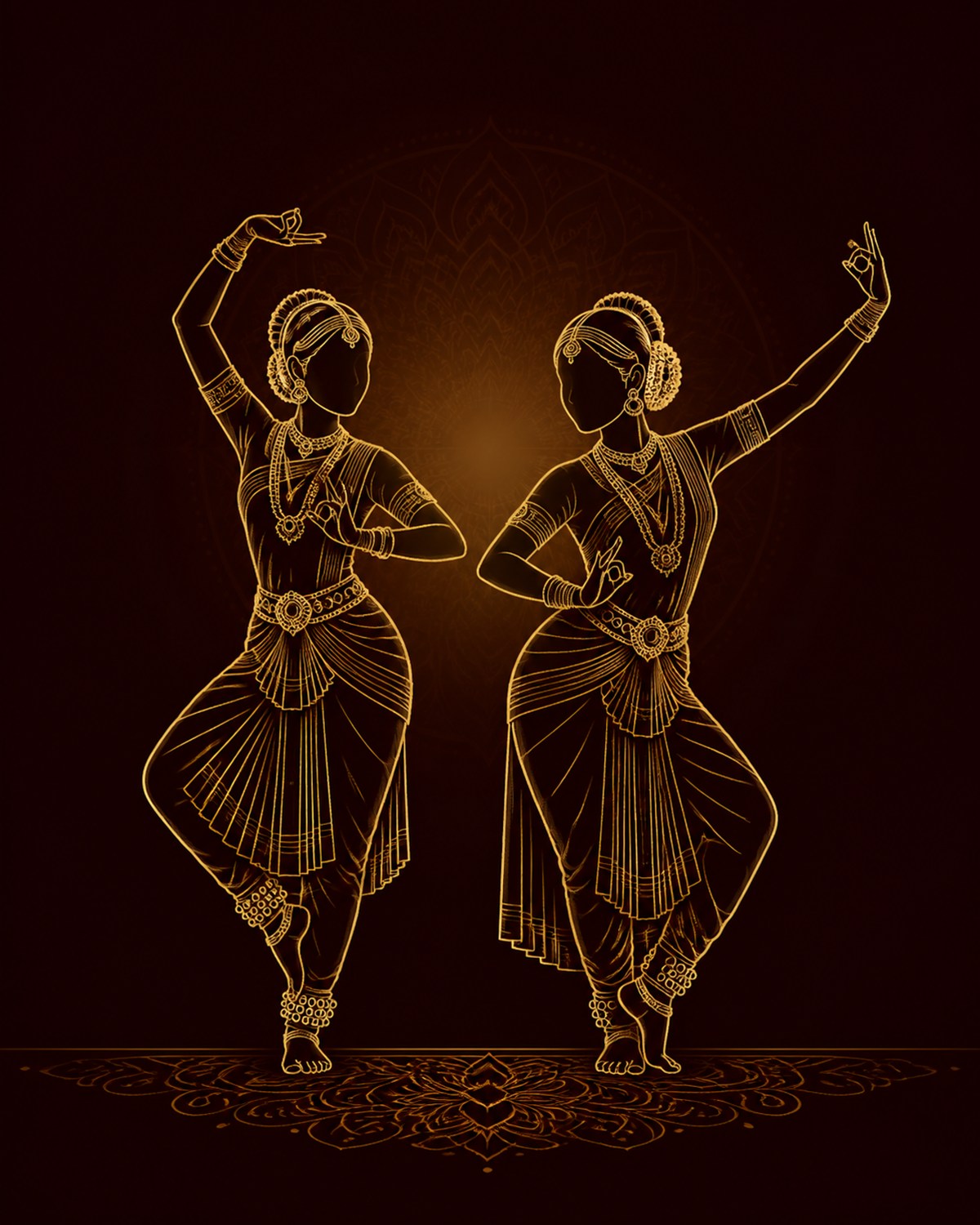
Abstract or “pure” dance: rhythmic movement, adavus, sculptural lines, jumps, turns, and mathematically shaped patterns.
Expressive dance in which movement and abhinaya interpret the emotional and poetic meaning of a composition.
Dramatic representation: character, situation, and narrative are embodied through a performer’s complete stage presence.
Bharatanatyam develops musical listening, physical discipline, memory, coordination, stamina, spatial awareness, and emotional intelligence. It connects learners with languages, literature, philosophy, history, textile traditions, percussion, and Carnatic music.
At its best, training also teaches humility: every performance rests on the work of gurus, composers, musicians, craftspeople, families, and generations of dancers.